Motion · UI xuất hiện
Chuyển động "có thân thể" của phần tử
Hai kiểu "có thân thể" cho phần tử: axial-stretch kéo giãn theo trục như kẹo dẻo, contact-shadow-lift nâng khỏi mặt phẳng với bóng tiếp xúc.
Nguồn: video-shotcraft (Vincent Wei) ↗ · Apache-2.0 · Composition Remotion (React/TSX) — có video preview, không có player trong trình duyệt
Biến thể
Kéo giãn theo trục dựa trên chênh lệch tốc độ — bay càng nhanh kéo càng dài (kéo giãn tối đa scaleX 2.2 / scaleY 0.72), ép dẹt rồi bật lại trong 8f khi đáp.
`p(f)−p(f−1)`
Nhấc lên trong 10f out-cubic: thẻ translateY(−28px) + scale(1.08), bóng elip riêng scale 1→1.72 / opacity 0.55→0.18 chạy ngược cùng tiến độ; rơi xuống 8f in-cubic + 2f ép nhẹ khi chạm.
Gọi tên nhấn mạnh từng thẻ; dọn đường cảm giác rời mặt phẳng cho đoạn 2.5D
Khi nào dùng
Bổ sung "thân thể đang thay đổi" bên cạnh "vị trí đang thay đổi": bay vào tốc độ cao cho thân thể của tốc độ (A), gọi tên thẻ cho bằng chứng lơ lửng (B); A phối với nhập cảnh lao ngang, B phối với chuyển động máy quay 2.5D và gọi tên từng thẻ.
Ý đồ
Các thẻ chuyển động trong thư viện đều quản "vị trí đang thay đổi" — bay vào, trượt, nảy, còn bản thân phần tử luôn là vật rắn. Hai kiểu này quản thân thể đang thay đổi: A cho tốc độ một thân thể nhìn thấy được — bay càng nhanh càng kéo dài theo trục chuyển động, như một miếng kẹo dẻo, khi đáp bị ép dẹt rồi bật lại thẳng, bản dịch UI của squash & stretch; B cho việc lơ lửng một bằng chứng đáng tin — khi thẻ nhấc lên, bóng ngay bên dưới phóng to và nhạt màu đồng bộ, như tờ giấy rời khỏi bàn, một câu thoại vật lý dọn đường cho chuyển động máy quay 2.5D theo nguyên tắc staging. Khác với smear-multiples: đó là bóng mờ đếm được (bóng ma rời rạc), A là kéo giãn liên tục (kẹo dẻo kéo sợi không đứt); khác với CameraMotionBlur: vệt mờ do màn trập là chuyện của máy quay, kéo giãn là chuyện của thân thể — đừng chồng cả hai lên cùng một phần tử.
Thời lượng & năng lượng
- Thời lượng: A ~4.7s / B ~5.3s
- Năng lượng: A: Trung bình cao / B: Thấp-trung
Công thức cảnh quay (bản gốc tiếng Trung — timing, easing, bảng tham số, lỗi hay gặp)
意图
库内运动卡全在管"位置在变"——飞入、滑动、弹跳,元素本身始终是刚体。 这两式管身体在变:A 给速度一个可见的肉身——飞得越快沿运动轴拉得 越长,一块糖稀,落点压扁回弹收正,squash & stretch 的 UI 翻译;B 给 悬浮一个可信的证据——卡抬起时正下方阴影同步放大变淡,纸片离桌, staging 法则给 2.5D 运镜垫的物理台词。与 smear-multiples 的区别:那是 可数残像(离散鬼影),A 是连续拉伸(糖稀不断丝);与 CameraMotionBlur 的区别:快门拖影是相机的事,拉伸是身体的事,同一元素别叠加。
两式选型
| 式 | 做法 | 适用 | |----|------|------| | A axial-stretch | 速度差分驱动轴向 scale:v=\|p(f)−p(f−1)\|,v<2px/f 不拉伸、≥140px/f 满拉伸(scaleX 2.2 / scaleY 0.72);落点 8f 压扁回弹 | 高速飞入/横冲入场;多卡错峰填坑 | | B contact-shadow-lift | 抬起 10f out-cubic:卡 translateY(−28px)+scale(1.08),独立椭圆阴影 scale 1→1.72 / opacity 0.55→0.18 同进度反向;落回 8f in-cubic + 2f 微压卡壳 | 逐张点名强调;2.5D 段落的离面铺垫 |
参数表
| 参数 | 典型值 | 调节手感 | |------|--------|----------| | A 拉伸映射 | v∈[2,140]px/f → 拉伸 0→满(scaleX 2.2/scaleY 0.72) | 峰值 <1.6 不可感;>2.6 读作故障拉丝 | | A origin/顺序 | transformOrigin 设运动后缘(右飞 100% 50%);translate 再 scale | origin 居中读作缩放不是拉伸;顺序反了位移跟着放大 | | A 落点回弹 | 8f out-cubic:scaleX 过冲 0.85、scaleY 1.1 再回 1 | 无回弹的拉伸像刹不住车 | | A 错峰 | 三卡起飞间隔 12f,飞行 36f | 同帧齐飞读不出各自的拉丝 | | B 抬升幅度 | −28px + scale 1.08 | 判例锁死:<12px 禁用(见已知坑) | | B 阴影 | 独立 radial-gradient 椭圆 div;卡本体 boxShadow: none | box-shadow 跟卡走,给不出"影子留在桌上" | | B 落地 | scale 0.99 卡壳 2f 再 5f 回弹到 1 | 无微压读作飘落,没有重量 | | 收尾 | A 末卡回弹后 62f / B 全落回后 35f 真静止 | 收尾帧须与 rest 态逐像素一致 |
已知坑
- demo 在灰阶/占位素材上调校通过——参数是调校起点非实战定稿,
首次实战须以真实素材回验
- B 微幅加码判例:原案 8px 抬升不可感,加码到 28px 才过——实战禁回调到 12px 以下,宁可不用不可用弱
- A 速度必须位置差分实算,不许拿 easing 进度近似——差分才保证
"低于阈值不拉伸",起步与将落时自动收正
- A 竖向运动轴要换:竖飞拉 scaleY 压 scaleX,origin 设上/下缘,
照抄横版参数会拉错轴(原案就把轴写反过)
- B 一次只抬一张——两张同时离桌,观众找不到被点名的是谁(P4)
- 声音:A 落点一声闷撞、B 抬起轻吸/落回轻放(sound-design §4.5)
参考实现
demos/ui-entrance/element-body-moves/ (AxialStretch.tsx / ContactShadowLift.tsx)
Mã nguồn tham chiếu (Remotion)
- demos/ui-entrance/element-body-moves/AxialStretch.tsx — https://raw.githubusercontent.com/Vincentwei1021/video-shotcraft/main/demos/ui-entrance/element-body-moves/AxialStretch.tsx
- demos/ui-entrance/element-body-moves/ContactShadowLift.tsx — https://raw.githubusercontent.com/Vincentwei1021/video-shotcraft/main/demos/ui-entrance/element-body-moves/ContactShadowLift.tsx
Component import fixture chung từ demos/_fixtures và helper từ assets/lib của repo; xem SKILL.md trong repo để biết quy trình render.
Mọi thứ trên trang này đều có bản máy đọc. Đưa agent link JSON, hoặc thêm MCP server gimgs rồi bảo nó tìm motion template.
- Tải JSON — trong đó có công thức cảnh quay (timing, easing, bảng tham số, lỗi hay gặp) và toàn bộ source TSX.
- Clone repo video-shotcraft; component import fixture chung từ demos/_fixtures và helper từ assets/lib.
- Đăng ký component thành <Composition> trong project Remotion rồi render bằng `npx remotion render`, hoặc dựng lại công thức bằng engine của bạn.
curl -s https://gimgs.net/motion/element-body-moves.jsongit clone https://github.com/Vincentwei1021/video-shotcraft
# component: demos/ui-entrance/element-body-moves/AxialStretch.tsx, demos/ui-entrance/element-body-moves/ContactShadowLift.tsx
npx remotion render <CompositionId> out.mp4claude mcp add --transport http gimgs https://gimgs.net/mcp
# then: search_motion_templates / get_motion_template("element-body-moves")Prompt
Use the video-shotcraft shot recipe "Chuyển động "có thân thể" của phần tử" (Remotion composition, Apache-2.0) published on gimgs.net.
Recipe JSON (prompt = timing/easing/parameter table/pitfalls, files = TSX source): https://gimgs.net/motion/element-body-moves.json
Raw TSX: https://gimgs.net/motion/element-body-moves/template.html
Repository: https://github.com/Vincentwei1021/video-shotcraft  (component: demos/ui-entrance/element-body-moves/AxialStretch.tsx, demos/ui-entrance/element-body-moves/ContactShadowLift.tsx; imports demos/_fixtures and assets/lib)
Spec: 1920x1080, 30 fps, 4.72s

1. Read the JSON and follow its "prompt" section (when to use, intention, parameter table, known pitfalls).
2. Adapt it for: <describe what you want>.
3. Either clone the repo, register the component as a <Composition> in a Remotion project and run npx remotion render <CompositionId> out.mp4 — or re-implement the recipe in your own engine (HTML/WAAPI works: keep the same timing and easing).
// ===== demos/ui-entrance/element-body-moves/AxialStretch.tsx =====
// axial-stretch —— 轴向拉伸速度感
// 三张 Card 从右外依次横向飞入落位,飞行途中沿运动轴速度驱动拉伸
// (scaleX 峰值 ≈2.2 / scaleY ≈0.72,糖稀拉丝感),落点 Back.out 式回弹。
// 速度用位置差分 p(f)-p(f-1) 驱动,低于阈值不拉伸。收尾真静止 ≥35f。
import React from 'react';
import { useCurrentFrame, interpolate, Easing } from 'remotion';
import { G, Card, TitleBlock } from '../../_fixtures/Fixtures';

const W = 1920;
const CARD_W = 380;
const CARD_H = 230;
const GAP = 60;
const ROW_W = 3 * CARD_W + 2 * GAP; // 1260
const ROW_X0 = (W - ROW_W) / 2; // 330
const ROW_Y = (1080 - CARD_H) / 2; // 425

const START_X = 1980; // 完全在画面右外
const FLIGHT = 36; // 飞行帧数
const STAGGER = 12; // 错峰
const FIRST = 10; // 首卡起飞帧
const SQUASH = 8; // 落点回弹帧数

const VEL_MIN = 2; // px/frame,低于此不拉伸
const VEL_REF = 140; // px/frame,达到此速度即满拉伸
const STRETCH_X = 1.2; // scaleX 峰值 1 + 1.2 = 2.2
const SQUISH_Y = 0.28; // scaleY 谷值 1 - 0.28 = 0.72

// poly(4) in-out:中段速度峰值 ≈ 4× 平均速度,够冲
const flightEase = Easing.inOut(Easing.poly(4));

const posAt = (f: number, start: number, targetX: number): number =>
  interpolate(f, [start, start + FLIGHT], [START_X, targetX], {
    easing: flightEase,
    extrapolateLeft: 'clamp',
    extrapolateRight: 'clamp',
  });

const FlyCard: React.FC<{ i: number; frame: number }> = ({ i, frame }) => {
  const start = FIRST + i * STAGGER;
  const targetX = ROW_X0 + i * (CARD_W + GAP);
  const land = start + FLIGHT;

  const x = posAt(frame, start, targetX);
  // 速度 = 位置差分(帧时间解耦,纯由位置函数决定)
  const v = Math.abs(posAt(frame, start, targetX) - posAt(frame - 1, start, targetX));
  const s = Math.min(Math.max((v - VEL_MIN) / (VEL_REF - VEL_MIN), 0), 1);

  const stretchX = 1 + STRETCH_X * s;
  const stretchY = 1 - SQUISH_Y * s;

  // 落点回弹:scaleX 过冲到 0.85 再回 1(横向被"撞停"压扁),8f
  const sqX = interpolate(frame, [land, land + SQUASH / 2, land + SQUASH], [1, 0.85, 1], {
    easing: Easing.out(Easing.cubic),
    extrapolateLeft: 'clamp',
    extrapolateRight: 'clamp',
  });
  const sqY = interpolate(frame, [land, land + SQUASH / 2, land + SQUASH], [1, 1.1, 1], {
    easing: Easing.out(Easing.cubic),
    extrapolateLeft: 'clamp',
    extrapolateRight: 'clamp',
  });

  return (
    <div
      style={{
        position: 'absolute',
        left: 0,
        top: ROW_Y,
        // 顺序:先 translate 再 scale;transformOrigin 设运动后缘(向左飞 → 右缘)
        transform: `translateX(${x}px) scaleX(${stretchX * sqX}) scaleY(${stretchY * sqY})`,
        transformOrigin: '100% 50%',
      }}
    >
      <Card w={CARD_W} h={CARD_H} seed={i + 1} />
    </div>
  );
};

export const AxialStretch: React.FC = () => {
  const frame = useCurrentFrame();
  const titleOp = interpolate(frame, [0, 10], [0, 1], {
    extrapolateLeft: 'clamp',
    extrapolateRight: 'clamp',
  });

  return (
    <div style={{ width: 1920, height: 1080, background: G.bg, position: 'relative', overflow: 'hidden' }}>
      <div style={{ position: 'absolute', top: 120, width: '100%', textAlign: 'center', opacity: titleOp }}>
        <TitleBlock text="AXIAL STRETCH" size={72} />
      </div>
      {/* 落位虚线槽,标出目标位置 */}
      {[0, 1, 2].map((i) => (
        <div
          key={`slot-${i}`}
          style={{
            position: 'absolute',
            left: ROW_X0 + i * (CARD_W + GAP),
            top: ROW_Y,
            width: CARD_W,
            height: CARD_H,
            border: `2px dashed ${G.bar}`,
            borderRadius: 14,
            boxSizing: 'border-box',
          }}
        />
      ))}
      {[0, 1, 2].map((i) => (
        <FlyCard key={i} i={i} frame={frame} />
      ))}
    </div>
  );
};


// ===== demos/ui-entrance/element-body-moves/ContactShadowLift.tsx =====
// contact-shadow-lift|接触阴影离面抬升
// 浅底上一排 3 张卡,逐张被"点名"抬起:卡 translateY(-28px)+scale(1.08),
// 其正下方独立椭圆阴影同步放大变淡——纸片离桌感;落回时阴影收紧变实,
// 落地 2f 卡壳 scale 0.99 微压。三张依次各来一遍。收尾真静止 ≥35f。
import React from 'react';
import { useCurrentFrame, interpolate, Easing } from 'remotion';
import { G, Card } from '../../_fixtures/Fixtures';

const outCubic = Easing.out(Easing.cubic);
const inCubic = Easing.in(Easing.cubic);

// 每张卡的局部时间轴(局部帧 t):
// [0,10)   抬起  out-cubic
// [10,28)  悬停 18f
// [28,36)  落回  in-cubic
// [36,38)  落地卡壳 scale 0.99
// [38,43)  回弹 0.99→1.0 out-cubic
// t<0 或 t>=43 完全静止(rest 态)
const LIFT_Y = -28; // 原案 -8 → 加码 -20 → QA 保险再到 -28
const LIFT_S = 1.08;

const cardMotion = (t: number) => {
  const y = interpolate(t, [0, 10], [0, LIFT_Y], {
    easing: outCubic, extrapolateLeft: 'clamp', extrapolateRight: 'clamp',
  }) + interpolate(t, [28, 36], [0, -LIFT_Y], {
    easing: inCubic, extrapolateLeft: 'clamp', extrapolateRight: 'clamp',
  });

  let s: number;
  if (t < 28) {
    s = interpolate(t, [0, 10], [1, LIFT_S], {
      easing: outCubic, extrapolateLeft: 'clamp', extrapolateRight: 'clamp',
    });
  } else if (t < 38) {
    s = interpolate(t, [28, 36], [LIFT_S, 0.99], {
      easing: inCubic, extrapolateLeft: 'clamp', extrapolateRight: 'clamp',
    });
  } else {
    s = interpolate(t, [38, 43], [0.99, 1], {
      easing: outCubic, extrapolateLeft: 'clamp', extrapolateRight: 'clamp',
    });
  }

  // 抬升进度 0(贴桌)→1(悬空),驱动阴影
  const lift = interpolate(t, [0, 10], [0, 1], {
    easing: outCubic, extrapolateLeft: 'clamp', extrapolateRight: 'clamp',
  }) - interpolate(t, [28, 36], [0, 1], {
    easing: inCubic, extrapolateLeft: 'clamp', extrapolateRight: 'clamp',
  });

  return { y, s, lift };
};

const CARD_W = 360;
const CARD_H = 220;
const GAP = 120;
const STARTS = [2, 42, 82]; // 三张卡依次点名,间隔 40f;末次动画止于 f125,留 35f 真静止

export const ContactShadowLift: React.FC = () => {
  const frame = useCurrentFrame();
  const rowW = CARD_W * 3 + GAP * 2;
  const left0 = (1920 - rowW) / 2;
  const top = (1080 - CARD_H) / 2 - 20;

  return (
    <div style={{ width: 1920, height: 1080, background: G.bg, position: 'relative', overflow: 'hidden' }}>
      {/* 假 dashboard 式顶栏,给浅底一点场景感 */}
      <div style={{ position: 'absolute', top: 0, left: 0, right: 0, height: 84, background: G.panel, borderBottom: `2px solid ${G.line}`, display: 'flex', alignItems: 'center', padding: '0 48px', gap: 24, boxSizing: 'border-box' }}>
        <div style={{ width: 40, height: 40, borderRadius: 10, background: G.side }} />
        <div style={{ height: 18, width: 220, background: G.bar, borderRadius: 9 }} />
        <div style={{ marginLeft: 'auto', width: 36, height: 36, borderRadius: 18, background: G.mid }} />
      </div>

      {[0, 1, 2].map((i) => {
        const t = frame - STARTS[i];
        const { y, s, lift } = cardMotion(t);
        const x = left0 + i * (CARD_W + GAP);

        // 独立接触阴影(不是 box-shadow):卡正下方椭圆径向渐变
        const shScale = 1 + 0.72 * lift;     // 1.0 → 1.72(对比再拉大)
        const shOpacity = 0.55 - 0.37 * lift; // 0.55 → 0.18
        const shW = CARD_W * 0.88;
        const shH = 44;

        return (
          <React.Fragment key={i}>
            <div
              style={{
                position: 'absolute',
                left: x + (CARD_W - shW) / 2,
                top: top + CARD_H - shH / 2 - 4,
                width: shW,
                height: shH,
                borderRadius: '50%',
                background: 'radial-gradient(ellipse at center, rgba(0,0,0,0.9) 0%, rgba(0,0,0,0.45) 42%, rgba(0,0,0,0) 72%)',
                transform: `scale(${shScale})`,
                opacity: shOpacity,
              }}
            />
            <Card
              w={CARD_W}
              h={CARD_H}
              seed={i + 2}
              style={{
                position: 'absolute',
                left: x,
                top,
                boxShadow: 'none',
                transform: `translateY(${y}px) scale(${s})`,
              }}
            />
          </React.Fragment>
        );
      })}
    </div>
  );
};
- Read the recipePrompt = when to use, intention, parameter table with typical values and how each one feels, known pitfalls. Treat values as calibrated starting points.
- Get the codetool: git
git clone https://github.com/Vincentwei1021/video-shotcraft && cd video-shotcraft && npm install - Register + rendertool: remotion
npx remotion render <CompositionId> out.mp4 # component: demos/ui-entrance/element-body-moves/AxialStretch.tsx, demos/ui-entrance/element-body-moves/ContactShadowLift.tsx - Or re-implementPort the timing/easing from the recipe to HTML + WAAPI (gimgs motion contract) or any engine; keep the same segment windows and easing.
| param | type | default | description |
|---|---|---|---|
| — | |||
Cùng danh mục
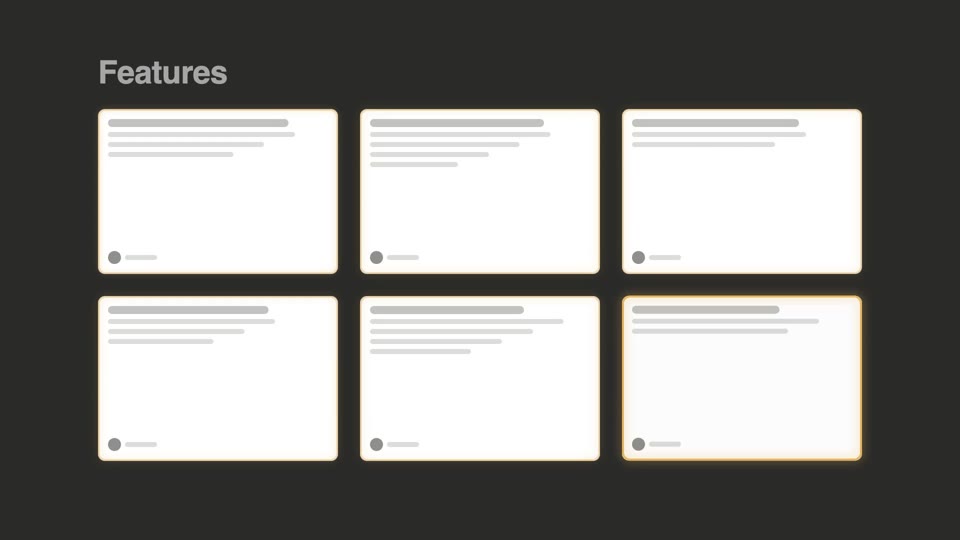
Hiện hình cả bức tường: ba kiểu
Ba kiểu vào hình hàng loạt cả bức tường — bento thắp sáng từng ô, lưới lật sóng, và bản vẽ blueprint hiện nét; tất cả hiện hình tại chỗ không dịch chuyển, bổ trợ cho deck-deal-flyin kiểu bay vào dịch chuyển.
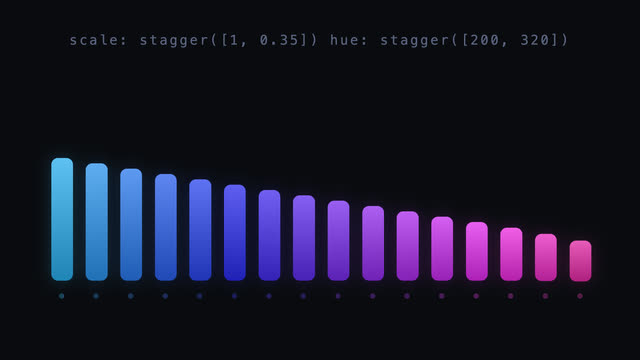
Cột nhập theo bậc thang giá trị
16 cột vào hình với delay là bậc thang thời gian, đồng thời chiều cao/sắc màu/dịch chuyển/độ mờ mỗi thuộc tính tự trải thành bậc thang giá trị từ đầu đến cuối; nhịp hai đổi gốc lệch nhịp về tâm, biên độ xung lấy tâm làm đỉnh trải lại.
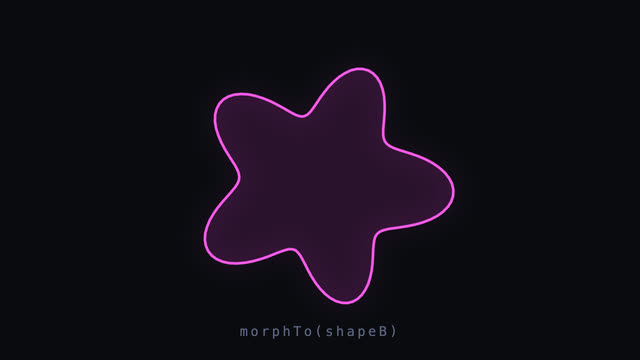
Biến hình SVG lặp vòng
Một viền khép kín 140 điểm biến hình mượt sang viền khác rồi biến lại, hai hình trước hết được lấy mẫu lại cùng số điểm trong tọa độ cực, nội suy bán kính từng điểm + inOutCubic, giữa chừng chèn hơi thở scale nhẹ, tự xoay chậm và sắc màu trôi 185°→305°.
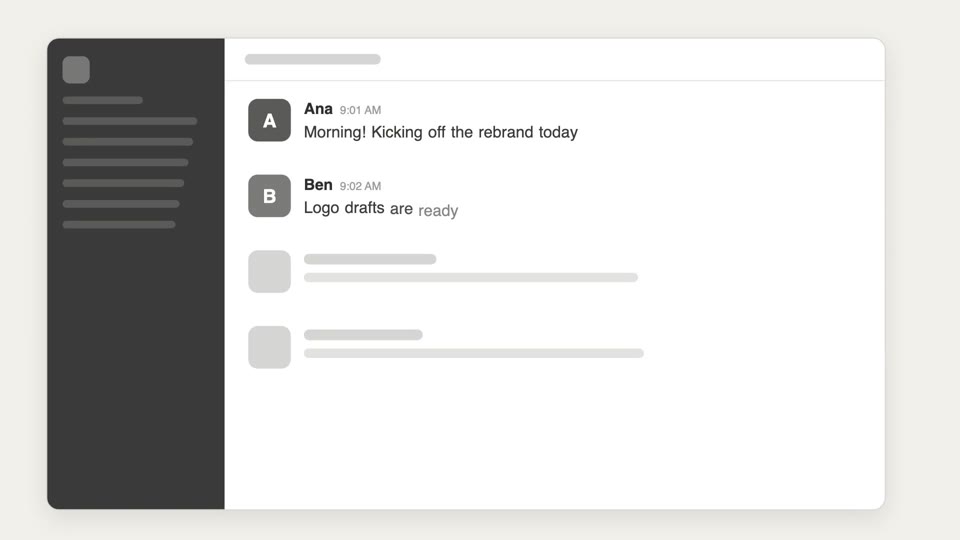
Hiện hình từ khung xương
Hiện hình ba tầng từ phác thảo đến khung xương đến nội dung — nét vẽ tay được thay bằng thanh xám khung xương rồi rõ nét thành UI thật.